KSAT Testing and Septic Site Evaluation: Why Hydraulic Conductivity Alone Is Not Enough
KSAT and hydraulic conductivity testing are increasingly written into septic system regulations, but research shows they are highly variable and unreliable when used alone. Learn why professional soil evaluation remains essential for determining true site suitability.

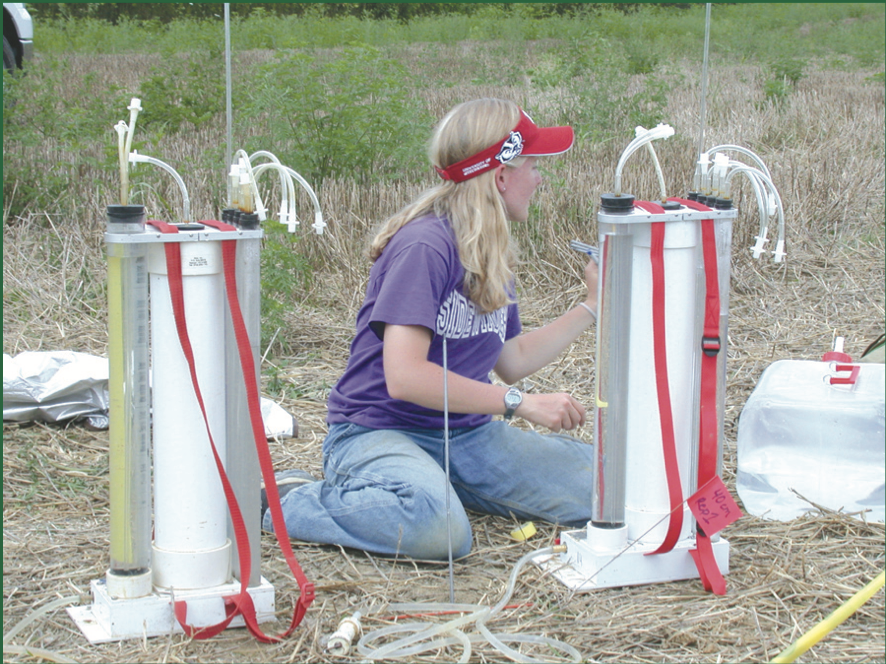
Across the onsite wastewater industry, KSAT and hydraulic conductivity testing are being incorporated more frequently into regulations as a way to evaluate soil suitability for septic systems. Regulators are understandably drawn to measurable, numeric data that appears objective and repeatable.
However, peer reviewed research and long standing industry experience clearly show that KSAT testing is not reliable when used as a standalone tool. While hydraulic conductivity data can support decision making, it must never replace a comprehensive soil evaluation performed by a trained soil evaluator or licensed soil scientist.
Why KSAT Is Being Emphasized in Regulations
KSAT, or saturated hydraulic conductivity, measures how quickly water moves through saturated soil. In theory, it provides a value that can be tied to loading rates and system sizing.
Several states, including Virginia through the Virginia Department of Health, are promoting regulatory shifts that further incorporate KSAT or hydraulic conductivity testing into onsite wastewater regulations.
The regulatory appeal is clear. KSAT produces a number that can be written into rules. The problem is that soil behavior cannot be reduced to a single number.
What the Research Shows About KSAT Reliability
KSAT Values Are Highly Variable
Scientific research consistently demonstrates that KSAT measurements vary significantly across short distances and between testing methods.
A peer reviewed study published in Ecological Engineering found that expert visual assessment of soil characteristics showed only moderate correlation with laboratory measured KSAT values, highlighting that conductivity testing alone does not reliably represent soil behavior across a site .
Research from Virginia Tech further shows that field measured KSAT values represent only a single point in time and space, and often fail to capture the variability that exists vertically and horizontally within a soil profile .
This variability means two KSAT tests conducted only feet apart can produce dramatically different results, even in the same soil series.
Testing Method and Protocol Significantly Affect Results
Multiple hydraulic conductivity testing methods exist, each with different limitations. Studies comparing these methods conclude that no single KSAT method provides consistently reliable results without proper context.
A technical review published in Journal of Environmental Science and Technology emphasizes that hydraulic conductivity measurements are highly sensitive to test protocol, soil disturbance, duration of testing, and operator technique, leading to uncertainty ranges exceeding 50 percent in some cases .
Additional research published in Water demonstrates that even under controlled conditions, measurement error alone can account for variability ranging from 2 percent to nearly 60 percent in estimated KSAT values .
Soil Suitability Is More Than Quantifying a Loading Rate
Evaluating a site for an onsite wastewater system involves far more than calculating how fast water moves through soil.
A proper soil evaluation considers:
- Soil texture and structure
- Depth to restrictive horizons
- Redoximorphic features and seasonal water tables
- Landscape position and slope
- Drainage patterns and site hydrology
- Local soil behavior and long term performance history
None of these factors can be fully captured by a hydraulic conductivity test.
Landscape position alone can dramatically affect system performance even when KSAT values appear acceptable. Soil texture changes within the profile influence both treatment and dispersal. Local knowledge of soil behavior over time often proves more reliable than any single test result.
The Critical Role of Trained Soil Evaluators and Soil Scientists
This is why trained soil evaluators and licensed soil scientists are indispensable to the onsite wastewater process.
These professionals are trained to interpret soil morphology, recognize limiting conditions, and evaluate sites holistically. KSAT testing can be a useful supplemental tool when interpreted by qualified professionals, but it must always be used in conjunction with a formal soil evaluation, not as a replacement.
Research consistently supports this integrated approach. Studies comparing pedotransfer functions and measured KSAT values confirm that numeric predictions alone are insufficient without professional field interpretation .
The Risk of Designing Systems Based on KSAT Alone
A growing concern in the industry is the increasing reliance on KSAT data by engineers without requiring a soil evaluation performed by a qualified individual.
Designing systems based solely on hydraulic conductivity values removes critical context, increases failure risk, and undermines professional accountability. This approach is not supported by soil science literature and is not aligned with long term system performance or public health protection.
Engineers using KSAT data alone without relying on a professional soil evaluation is not the direction the industry should be heading.
The Responsible Path Forward
Hydraulic conductivity testing has a place in modern onsite wastewater regulation, but that place must be clearly defined.
KSAT should be:
- A supplemental data point
- Used alongside soil morphology evaluation
- Interpreted by trained professionals
- Integrated with landscape and site specific knowledge
Under no circumstances should KSAT be relied on as the sole method of evaluating site suitability for septic systems.
Final Thought
Research, field experience, and decades of industry knowledge all point to the same conclusion.
Soil evaluation is a professional discipline, not a formula.
Numeric data can inform good decisions, but only trained soil evaluators and licensed soil scientists can provide the context required to protect public health and ensure long term system performance.
📚 Research and Technical References
Hydraulic Conductivity Variability and Measurement Limitations
- Soil Saturated Hydraulic Conductivity (Ksat) Global Database
A large compilation showing how Ksat values vary widely across soils and measurement contexts, underscoring the variability of hydraulic conductivity measurements.
https://essd.copernicus.org/preprints/essd-2020-149/essd-2020-149-ATC3.pdf ESSD - Study of Hydraulic Conductivity Variability Using ASTM Methods Research showing hydraulic conductivity measurements can vary significantly even under standardized laboratory methods, indicating inherent measurement uncertainty.
(Variability of Saturated Hydraulic Conductivity Measurements Made Using a Flexible-Wall Permeameter) https://www.researchgate.net/publication/298429385_Variability_of_Saturated_Hydraulic_Conductivity_Measurements_Made_Using_a_Flexible-Wall_Permeameter ResearchGate - Spatial Variability of Soil Physical and Hydraulic Properties
Peer-reviewed study demonstrating that saturated hydraulic conductivity and other soil parameters vary at field scale, supporting the idea that single point measurements (like KSAT) are not fully representative without broader context.
https://www.mdpi.com/2073-4441/11/7/1434 MDPI
Hydraulic Conductivity Testing in Septic Soil Contexts
- Hydraulic Conductivity around Septic Tank Systems
Examines soil hydraulic properties around septic systems and highlights the complexity of linking KSAT to real infiltration behavior.
https://www.sciencedirect.com/science/article/pii/S101836471830884X