Pitt County Just Landed $250K to Fix Failing Septic Systems — and It Signals Something Bigger for North Carolina
Pitt County won $250K under NC's new CWSRF Decentralized Wastewater Pilot — state revolving fund dollars flowing directly to failing septic systems.
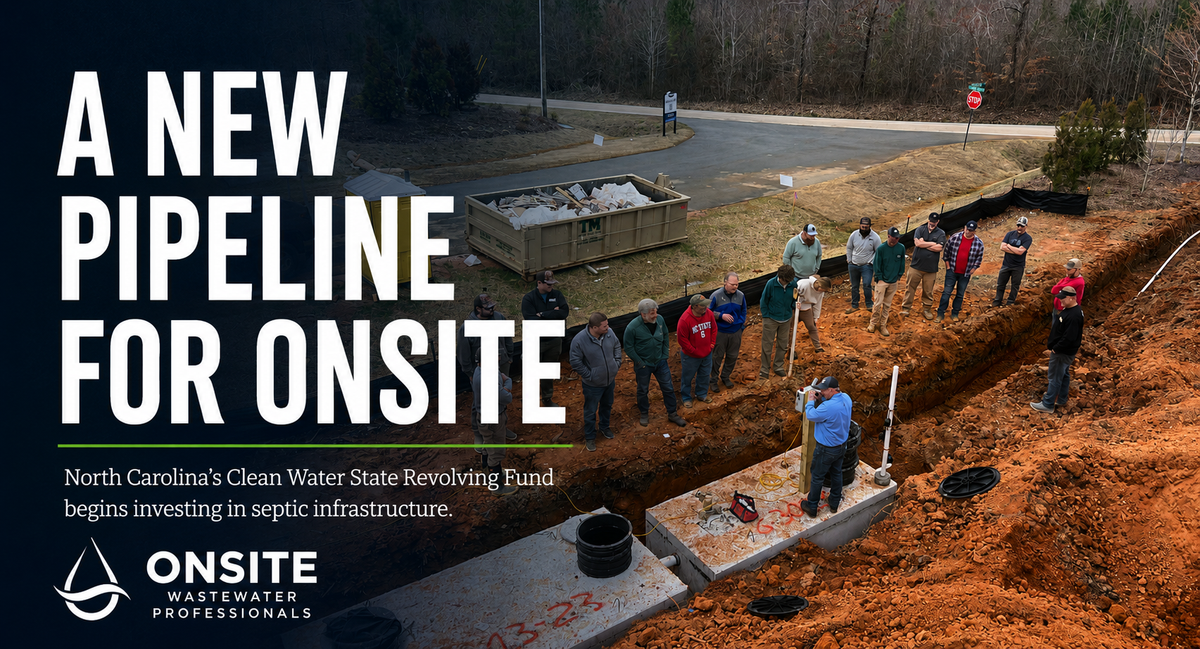
For decades, the Clean Water State Revolving Fund has been the workhorse that finances sewer plants and collection lines — big pipes, big pumps, big municipal projects. Onsite systems, which serve roughly half of North Carolina's population, rarely saw a dime of it.
That just changed.
On July 16, Governor Josh Stein and the NC Department of Environmental Quality announced $244 million in funding for 45 drinking water and wastewater projects across 28 counties. Buried in the list — easy to miss next to the multimillion-dollar treatment plant upgrades — was a line item that should have every onsite wastewater professional in the state paying attention:
Pitt County will receive a $250,000 loan from the Clean Water State Revolving Fund (CWSRF) Decentralized Wastewater Treatment Systems Pilot Program to repair or replace failing septic systems.
It's a small number in a $244 million announcement. It's a big deal for our industry. Here's why.
What the Decentralized Pilot Program actually is
The Decentralized Wastewater Treatment Systems Pilot Program is a new carve-out inside North Carolina's CWSRF, described in DEQ's current CWSRF Intended Use Plan. The key mechanics:
- It's a pass-through model. A local government unit — a county, city, town, or sanitary district — applies for the funding, then distributes it to qualified homeowners to repair or replace failing onsite wastewater systems, single-family non-discharge systems, or single-family discharge facilities.
- The money can be very close to free. The state offers principal forgiveness and/or 0% interest loans. An applicant that passes funds exclusively to income-qualified recipients can receive up to 100% principal forgiveness, capped at $250,000. Applicants directing at least half the money to qualified recipients or disadvantaged areas can get up to 50% forgiveness, capped at $500,000.
- It's deliberately small — for now. The pilot is limited to $1.5 million of available CWSRF principal forgiveness statewide. This is a proof of concept.
- The local government sets the rules. Each awardee establishes homeowner qualification criteria in consultation with the Division of Water Infrastructure, and is responsible for verification and documentation.
Worth noting: Pitt County's $250,000 award lands exactly at the cap for the 100%-forgiveness tier. DEQ hasn't published the specific loan terms, but the structure of the program suggests this money is designed to reach homeowners who couldn't otherwise afford a repair — not to sit on the county's books as debt.
Why this matters more in North Carolina than almost anywhere else
North Carolina is a septic state. Research published in PLOS Water (Sprouse et al., 2024) puts it plainly: about half of North Carolinians rely on onsite systems, roughly double the national average — and an estimated 10–20% of those systems experience some kind of failure each year. Official numbers dramatically undercount the problem: in 2018–2019, only 39 of 100 counties reported failures at all.
The same research found that counties leaning hardest on septic tend to score highest on the Social Vulnerability Index — concentrated in eastern North Carolina, where high water tables, sandy soils, aging systems, and repeated hurricane flooding make the coastal plain one of the toughest places in the country to keep an onsite system healthy. Pitt County sits squarely in that geography, in the Tar-Pamlico basin, where every failing drainfield is a nutrient and pathogen source headed toward waters that already carry a load.
A failed system is a public health problem, an environmental problem, and — for the family living above it — a five-figure problem with no financing. Until now, the honest answer for many of those households was: there's no program for you.
The precedent is the point
EPA has technically allowed CWSRF dollars to fund decentralized systems for years. Very few states built a working mechanism to actually do it. North Carolina now has one, and Pitt County is the proof-of-concept award.
If this pilot works — if the county can qualify homeowners, move money, and document fixed systems — the case for growing that $1.5 million ceiling gets much easier to make. Onsite wastewater has spent decades explaining that decentralized infrastructure is infrastructure. A state revolving fund treating a drainfield replacement the same way it treats a sewer main is that argument, won.
What onsite professionals should do now
If you work with a county or local government: the next funding round opens August 4, with applications due 5 p.m. September 30, 2026. The Division of Water Infrastructure is running in-person application trainings August 4–12 in Hickory, Asheville, RTP/Durham, and Kinston, plus a virtual session August 10. If your county has a backlog of known failures and no repair fund, this is the conversation to start this month.
If you're a contractor in Pitt County or nearby: repairs and replacements funded through this pilot will need permitted, licensed work — and a county program that runs smoothly will lean on contractors who understand documentation. Introduce yourself to the county now, not after the money starts moving.
If you're anywhere else in North Carolina: watch how Pitt County structures homeowner eligibility and contractor participation. This is the template your county will copy.
Sources: NC Governor's Office / DEQ announcement, July 16, 2026 · NC DEQ CWSRF Intended Use Plan (rev. Feb 2026) · Sprouse et al., "Septic systems in North Carolina: A neglected half of the state?", PLOS Water, 2024 · EPA: Funding for Septic Systems