Virginia Septic Professionals: A Licensed Person Must Be on Every Job Site
Virginia's updated onsite sewage licensing regulations are in effect. Here's what installers, operators, and soil evaluators need to know about working on job sites, supervising employees, and pumping alternative systems.

Virginia's Department of Professional and Occupational Regulation (DPOR) made several changes to the state's onsite sewage professional licensing regulations in December 2025. One of the most important changes affects how businesses staff their jobs.
An appropriately licensed journeyman or master must be physically present when regulated onsite sewage work is being performed.
This requirement is now written directly into 18VAC160-40-515 and applies to installers, operators, and soil evaluators. For companies that have been sending unlicensed employees to perform regulated work under the remote supervision of a master, this is an important requirement to understand.
A Master Doesn't Have to Be on Every Job. A Journeyman Can Be.
This is probably the most important distinction in the regulations.
You do not need a master license holder physically present at every job site. An appropriately licensed journeyman can satisfy the on-site requirement.
The journeyman must hold the appropriate license for the work being performed and the type of system involved.
For example:
- Conventional installations: An appropriately licensed conventional or alternative installer must be on site.
- Alternative installations: An appropriately licensed alternative installer must be on site.
- Conventional system operation: An appropriately licensed conventional or alternative operator must be on site.
- Alternative system operation: An appropriately licensed alternative operator must be on site.
- Soil evaluation and design: An appropriately licensed journeyman or master soil evaluator must be present, with the proper license classification for the work.
A journeyman can work at a job site without the master physically present, provided the journeyman remains under the required direct supervision of a master.
What you cannot do is substitute an unlicensed employee for the licensed person required to be on site simply because a master is available by telephone.
Does Everyone on the Job Need a License?
No. The regulations do not require every employee assisting with onsite sewage work to hold a professional license. However, an appropriately licensed journeyman or master must be physically present where regulated activities are performed. There is also an additional requirement for installers.
Under 18VAC160-40-515(A), the person making installation decisions and the individual executing the approved installation must hold the appropriate journeyman or master installer license. Unlicensed employees can assist with work, but they cannot take the place of the licensed installer responsible for the installation.
What Does This Mean for Businesses Operating Multiple Crews?
Consider a company with one master operator and three unlicensed employees. The company has traditionally sent those employees to different locations to perform regulated maintenance while the master remains available by telephone. Under the current regulations, that arrangement does not satisfy the on-site licensing requirement. Each location where regulated work is performed must have an appropriately licensed journeyman or master present.
However, if those three employees obtain the appropriate journeyman licenses, they can work at separate locations while remaining under the required direct supervision of the master.
The difference is having licensed journeymen working under a master versus having unlicensed employees working without a licensed person on site.
This could affect how businesses schedule crews, hire employees, and train new professionals.
How Long Does It Take to Become a Journeyman?
For businesses hiring new employees, the experience requirements for journeyman licensure are especially important. Virginia offers several pathways depending on the license classification, education, training, and existing professional credentials.
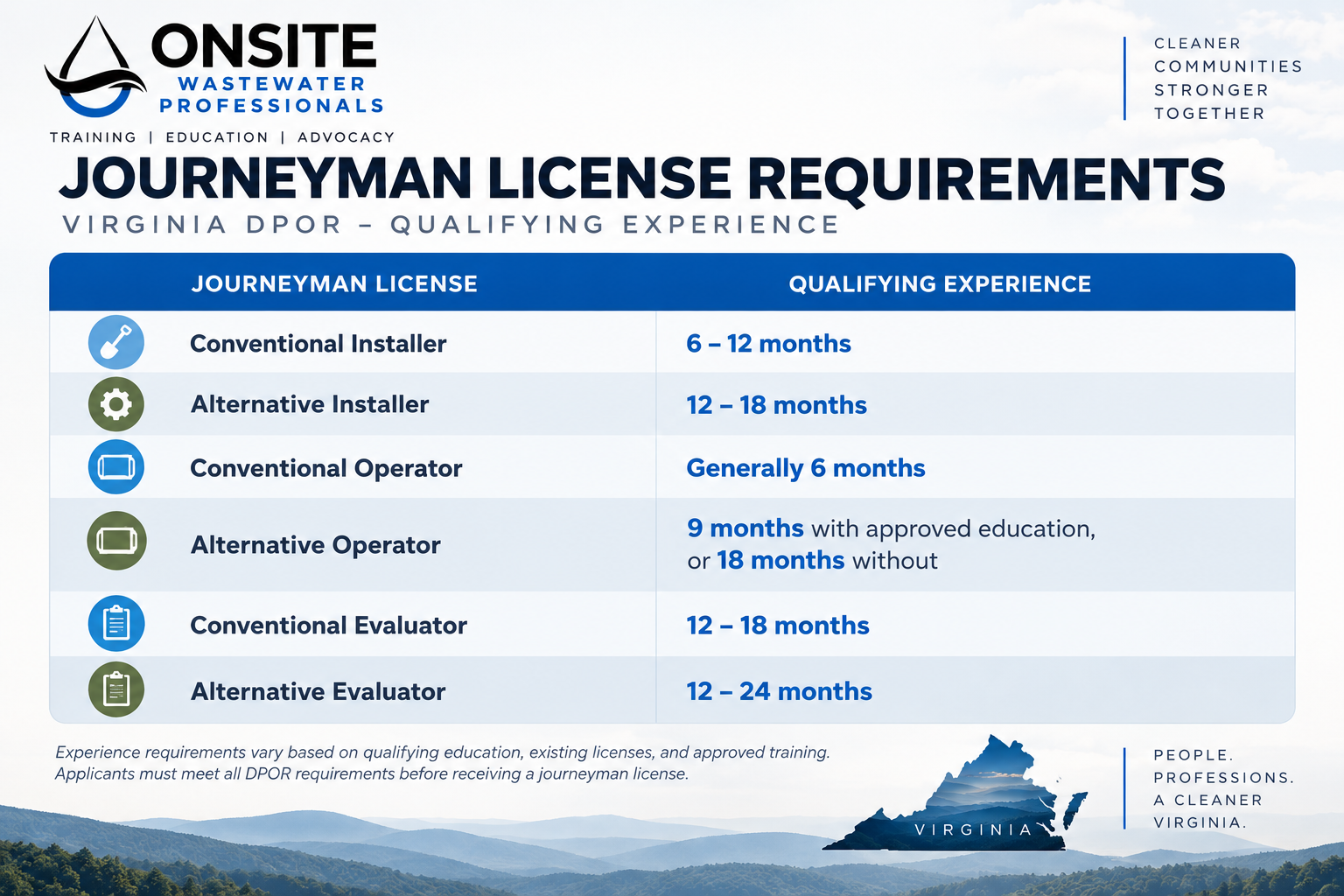
These are common experience pathways, not an exhaustive list of every licensing option. Some applicants may qualify through other routes or receive allowable education credit. Applicants must also satisfy DPOR's application requirements and receive their licenses.
For a new employee without previous qualifying experience, this means it may take several months or longer before they can serve as the licensed professional on a job site without another licensed person physically present.
A journeyman must still work under the direct supervision of a master.
Another Important Change: Conventional Operators Can Pump Alternative Systems
The December 2025 regulations also introduced an important provision for conventional operators. Under 18VAC160-40-520, a conventional onsite sewage system operator may pump an alternative system without the alternative operator physically present, provided certain conditions are met.
The conventional operator must have the appropriate sewage handling permit issued by VDH or a local independent health department. The pumping must also be performed at the request and direction of an alternative onsite sewage system operator.
There is one important limitation.
The conventional operator is only authorized to pump the tank. This provision does not authorize other operation or maintenance activities on the alternative system.
A journeyman conventional operator may perform this pumping under the same conditions, while remaining subject to the applicable master-supervision requirements. This provision gives conventional operators a clearly defined role in pumping alternative systems without requiring the alternative operator to be physically present for the pumping itself. Virginia Law
Frequently Asked Questions
Does a master have to be physically present at every job?
No. An appropriately licensed journeyman can satisfy the on-site requirement. The journeyman must still work under the required direct supervision of a master.
Can an unlicensed employee work alone if a master is supervising by telephone?
Not when performing regulated work covered by the on-site licensing requirement. An appropriately licensed journeyman or master must be physically present. Unlicensed employees can assist with work, but they cannot replace the licensed professional required at the job site.
Can one master supervise multiple journeymen working at different locations?
Yes, provided the required supervision arrangements are maintained. Each job site must have an appropriately licensed journeyman or master present. The master and journeyman must also maintain the employment or written contractual relationship required by 18VAC160-40-510.
Can a conventional operator work on an alternative system?
Generally, a conventional operator cannot perform activities requiring an alternative operator license. However, 18VAC160-40-520 provides a specific exception for pumping alternative systems. The conventional operator must have the appropriate sewage handling permit and perform the pumping at the request and direction of an alternative operator.
Does the alternative operator have to be present when a conventional operator pumps an alternative system?
No. The regulation expressly allows the conventional operator to pump the tank without the alternative operator physically present. However, the alternative operator must request and direct the pumping.
Can a journeyman conventional operator pump an alternative system?
Yes. A journeyman conventional operator may perform the pumping under § 520, provided all applicable conditions are met, including the sewage handling permit and master-supervision requirements.
Can a conventional operator clean filters, adjust equipment, or perform other maintenance on an alternative system?
Not under this exception. Section 520 only authorizes pumping the tank. It does not authorize the conventional operator to perform other alternative-system operation or maintenance.
Can an unlicensed employee pump an alternative system alone under the direction of an alternative operator?
No, not under the exception in § 520. That provision authorizes conventional onsite sewage system operators who meet its requirements. It does not extend the same permission to unlicensed employees.
Do the on-site licensing requirements apply to soil evaluators?
Yes. An appropriately licensed journeyman or master soil evaluator must be present where regulated soil evaluation and design activities are performed. The license classification must be appropriate for the work.
When did these regulations take effect?
December 17, 2025. The on-site licensing requirements in § 515 and the alternative-system pumping provision in § 520 became effective as part of the updated regulations.
What Virginia Businesses Should Do Now
These regulations make it important for businesses to review how they staff their jobs. If your company operates multiple crews, make sure each location where regulated work is performed has an appropriately licensed journeyman or master physically present.
If you are hiring new employees, consider how long it will take them to qualify for journeyman licensure before they can serve as the licensed person on a job. And if your company pumps alternative systems, review the new provision in § 520. It provides an opportunity for conventional operators to perform this work, but only under the conditions established in the regulation.
The bottom line: A master does not have to be at every job, but an appropriately licensed journeyman or master must be physically present whenever regulated onsite sewage work is performed.
Understanding these requirements will help Virginia's installers, operators, and soil evaluators plan their work, train employees, and maintain compliance.
Read the Regulations
- 18VAC160-40-515 — Licensee Responsibilities for Regulated Activities
- 18VAC160-40-510 — Master Licensee Supervision Requirements
- 18VAC160-40-520 — Pumping Alternative Systems by Conventional Operators
- Virginia Onsite Sewage System Professionals Licensing Regulations
Onsite Wastewater Professionals provides training, continuing education, and industry information for onsite wastewater professionals. This article is intended as general regulatory guidance. Contact DPOR for clarification about specific licensing or supervision situations.